
THE MATERIALS
Everything an instructor needs to teach Lean Six Sigma in-house
One slide deck, one student PDF, ready-to-run JASP data sets, the LSS Toolkit, and live quiz games. Every piece is built to work together, so your instructors can open the files and start teaching.
WHAT’S INCLUDED
1 PowerPoint deck with instructor notes
1 Folder of instructor files with JASP analyses and answer keys to the exercises
1 Searchable student PDF
60+ JASP data sets
60+ LSS toolkit templates and tools
12 Live quiz games, one for each training day
300+ GB/BB exam questions (optional add-on)
8 days
Green Belt | 33 modules
+4 days
Black Belt | +7 modules
ASQ and IASSC
Body of knowledge aligned
WCAG AA
Accessible by design
$0
Software cost of JASP
WHAT’S COVERED
40 modules, from project selection to designed experiments
-
Introduction: Lean, Theory of Constraints, Six Sigma, Lean Six Sigma (DMAIC), Design for Six Sigma (DMADV)
LSS infrastructure: LSS deployment, Hoshin Kanri, SWOT, PEST, roles and responsibilities, LSS software
LSS project selection: Prioritization (Critical To) matrix, project selection matrix, project portfolio, Cost of (Non) Quality -
Voice of the Customer: VoC, customer segmentation, baseline research, interviews, focus groups, surveys, Kano model, affinity diagram, VoC table, CTQ requirements, decision trees
Business benefit assessment: Benefit assessment template, hard financial, soft financial, and soft non-financial benefits
IS / IS NOT analysis
SIPOC
Change management: Change readiness assessment, team member identification, kick-off meeting, team motivation, team growth stages, team success factors, GRPI checklist, stakeholder management, communication management
Project charters -
Process mapping: Flowcharts, cross-functional deployment flow, Value Stream Map (VSM), top-down map, input/output (x/y) map, spaghetti diagram, value analysis and waste, Lean metrics and equations, quick wins
Data collection plan: Operational definitions, sampling plan, data types
Basic statistics: Descriptive and inferential statistics, central tendency, variability, the normal distribution, probability
Introduction to JASP: Histogram, stem-and-leaf display, boxplot, individual value plot, interval plot, scatterplot, time series plot, X-mR chart, P chart, Q-Q plot, bar chart, Pareto chart
Measurement systems analysis: Accuracy (bias, linearity, stability), discrimination (rule of 10), precision (gage R&R), attribute agreement analysis
Capability analysis: Process stability, process capability, sigma quality level, capability indices (Cpk, Ppk, etc.), rolled throughput yield
Risk management: Risk management plan
Project management: Work breakdown structure, RACI, activity network diagram, Gantt chart, DMAIC project planner, affinity diagram, interrelationship digraph, tree diagram, prioritization matrix, matrix diagram, process decision program chart, storyboard, phase reviews -
Potential root cause identification: IS / IS NOT analysis, fault tree analysis, decision trees, 5 Whys, process mapping, C&E diagram, C&E matrix
Process data stratification: Graphical analysis, concentration diagram, multi-vari chart, contrasts
Introduction to inferential statistics: Central limit theorem, standard error of the mean, confidence intervals, hypothesis testing, power and sample size, normality test
Hypothesis testing: 1-sample, 2-sample, and paired t tests, ANOVA, 2-variance test, test for equal variances, correlation, simple linear regression, 1- and 2-proportion tests, chi-square test, chi-square goodness of fit, root cause assessment -
Potential solution identification: Analytical thinking, benchmarking, brainstorming, nominal group technique, solution mapping, lateral thinking
Solution selection: Removing misfits, multi-voting, analytical hierarchy process, solution selection matrix, force field analysis, Pugh matrix
Introduction to designed experiments
FMEA: Failure mode and effects analysis
Lean tools for implementing improvements: Waste elimination, 5S, continuous flow, pull systems, batch size reduction, Kanban, workload balance, constraints and pacemakers, work layout, point-of-use storage, portable equipment, quick changeover
Piloting solutions: Implementation planning, pilots -
Statistical process control: OCAP, X-mR, Xbar-R, Xbar-S, P, nP, U, and C charts
Lean tools for sustaining gains: Standard work, visual management, mistake proofing, TPM, OEE, Kaizen events, training
Control plans
Validating improvements: Process stability, process capability
Sustaining change: Sustainable change assessment
Project close-out: Lessons learned, replicating opportunities, recognition, close-out meeting, auditing -
Non-normal data techniques: Box-Cox and Johnson transformations, 1-sample Wilcoxon, Mann-Whitney, Kruskal-Wallis, non-normal SPC and capability
Advanced statistics: Non-linear, multiple, and logistic regression, general linear model, randomized block and Latin square designs, machine learning, multivariate tools
Advanced SPC and time series: EWMA, Laney P′ and U′ charts, rare events (G and T) charts, ARIMA
2k full factorial DoEs: Center points, blocks
2k-p fractional factorial DoEs: Sparsity of effects, confounding (aliasing), sequential experimentation
Optimizing DoEs: General full factorials, response surface methods, robust design (Taguchi), mixture designs, EVOP, conjoint analysis
Advanced team management: Coaching, conflict management, meeting facilitation, decision making, training
HOW IT FITS TOGETHER
Every concept moves from slide to data to project
The materials follow one thread through each module. Learners see the idea, try it on real data, and leave with a tool they can use on their own project.
Step 1
Instructor teaches
From the slide deck, with talking points in the notes.
Step 2
Learners follow along
In the student PDF, which follows the same structure as the deck.
Step 3
Everyone runs the analysis
In JASP, using the matching data set.
Step 4
Learners do the exercises
Individually or in teams, focusing on their own projects or simulations using JASP and the LSS toolkit.
INSTRUCTOR SLIDE DECK
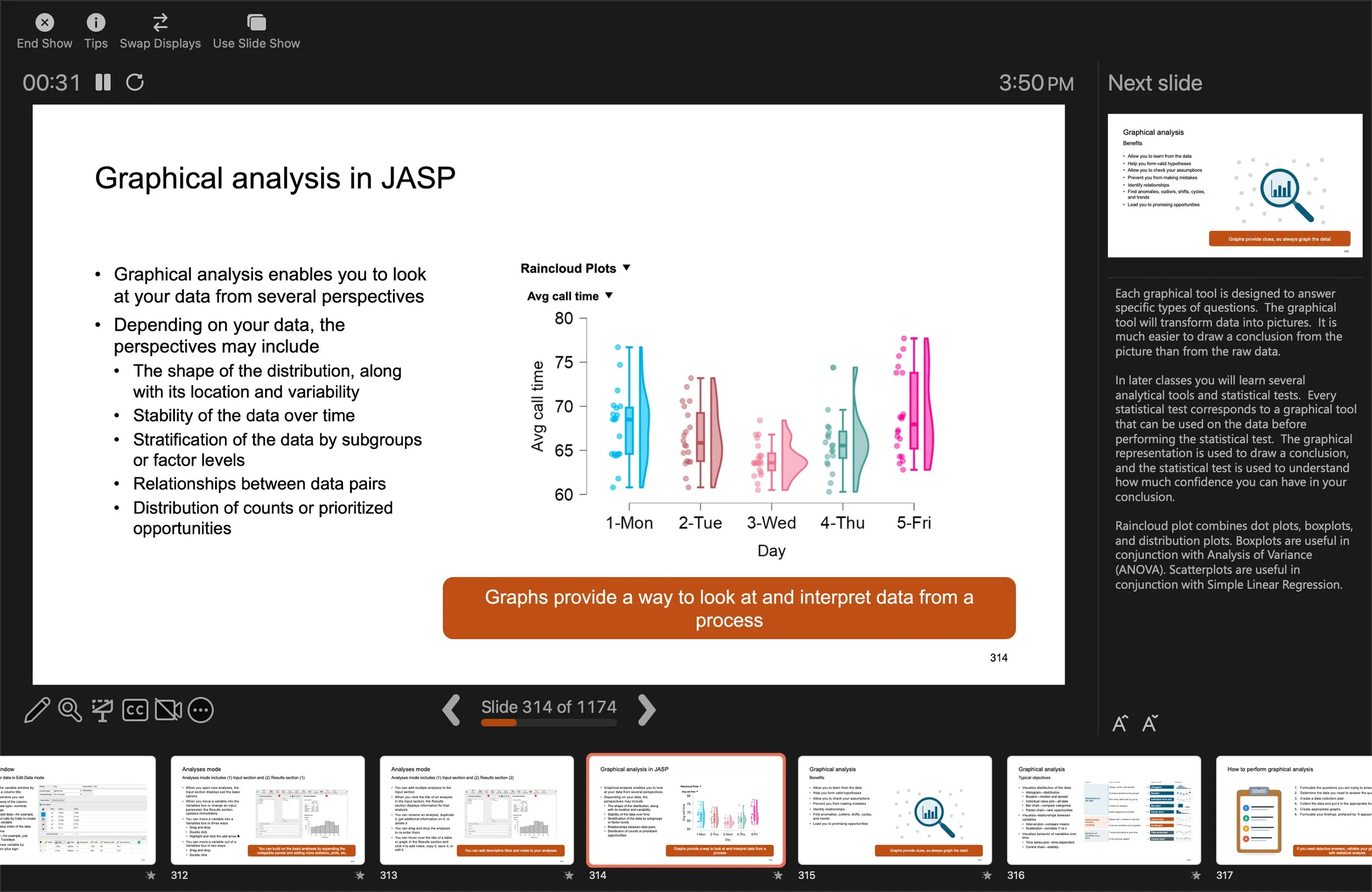
Screenshot of presenter view with notes.
One PowerPoint file. Notes on every slide.
Green Belt and Black Belt modules live in a single, easy-to-navigate deck, so instructors never hunt for the right file. The notes guide them through what to say and what to demonstrate.
✔ Instructor notes on every slide
✔ Lean and Six Sigma taught as one integrated method
✔ Consistent slide titles, so no one loses their place
✔ Proven exercises and simulations that make the learning stick
STUDENT PDF
All student materials in one searchable file
Learners get one PDF they can search, bookmark, and keep long after class. It follows the deck so no one gets lost, and every image carries alt text.
Format: PDF · Works with: any PDF reader and screen readers

Screenshot of student pdf with navigation pane.
60+ JASP DATA SETS
Real data for every demonstration and exercise
Each analysis in the deck has a matching data set, ready to open in JASP. Free, open-source software means no license costs for you or your learners, on Windows, Mac, or Linux.
Opens in: JASP · Software cost: $0
THE LSS TOOLKIT
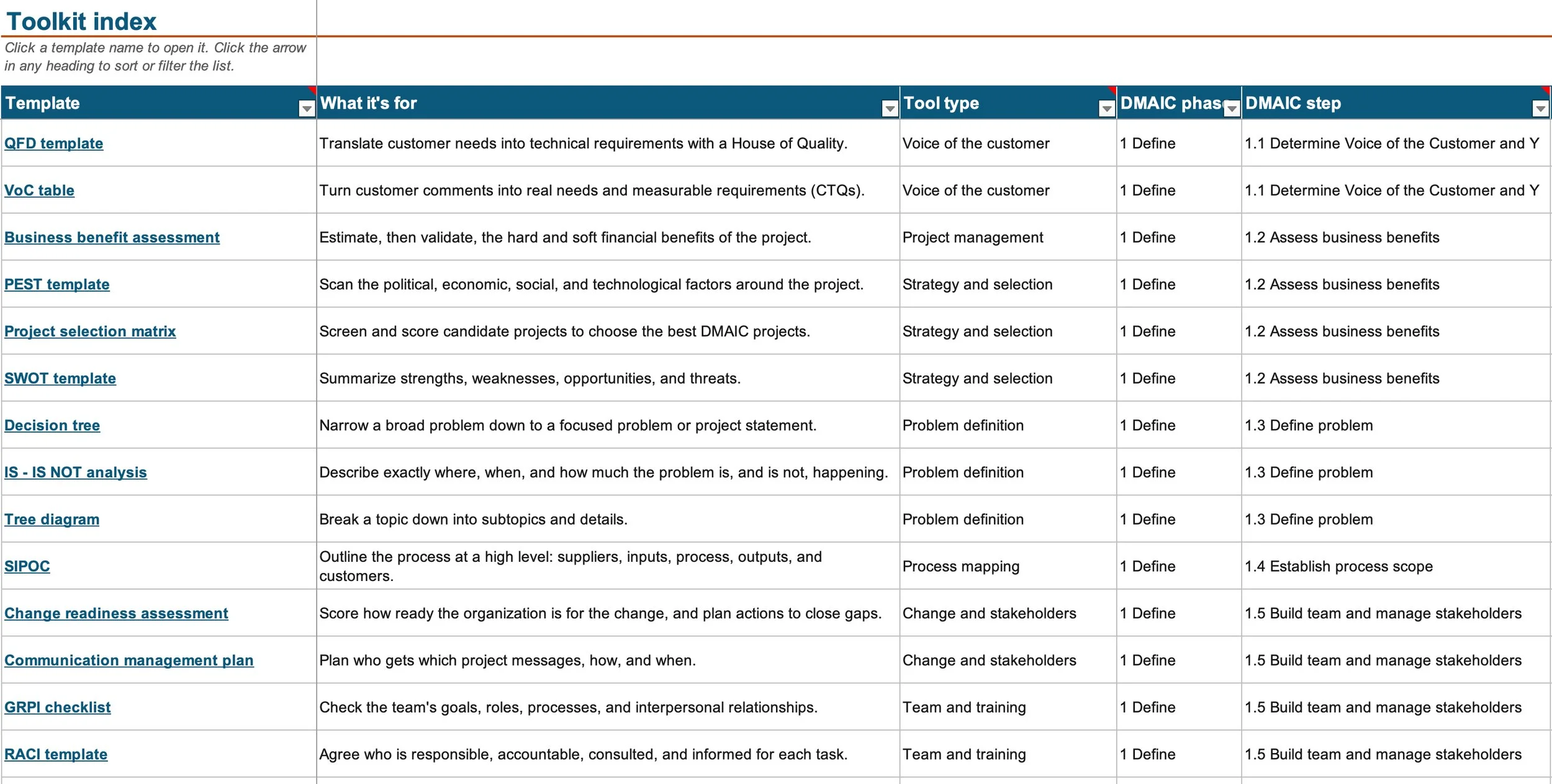
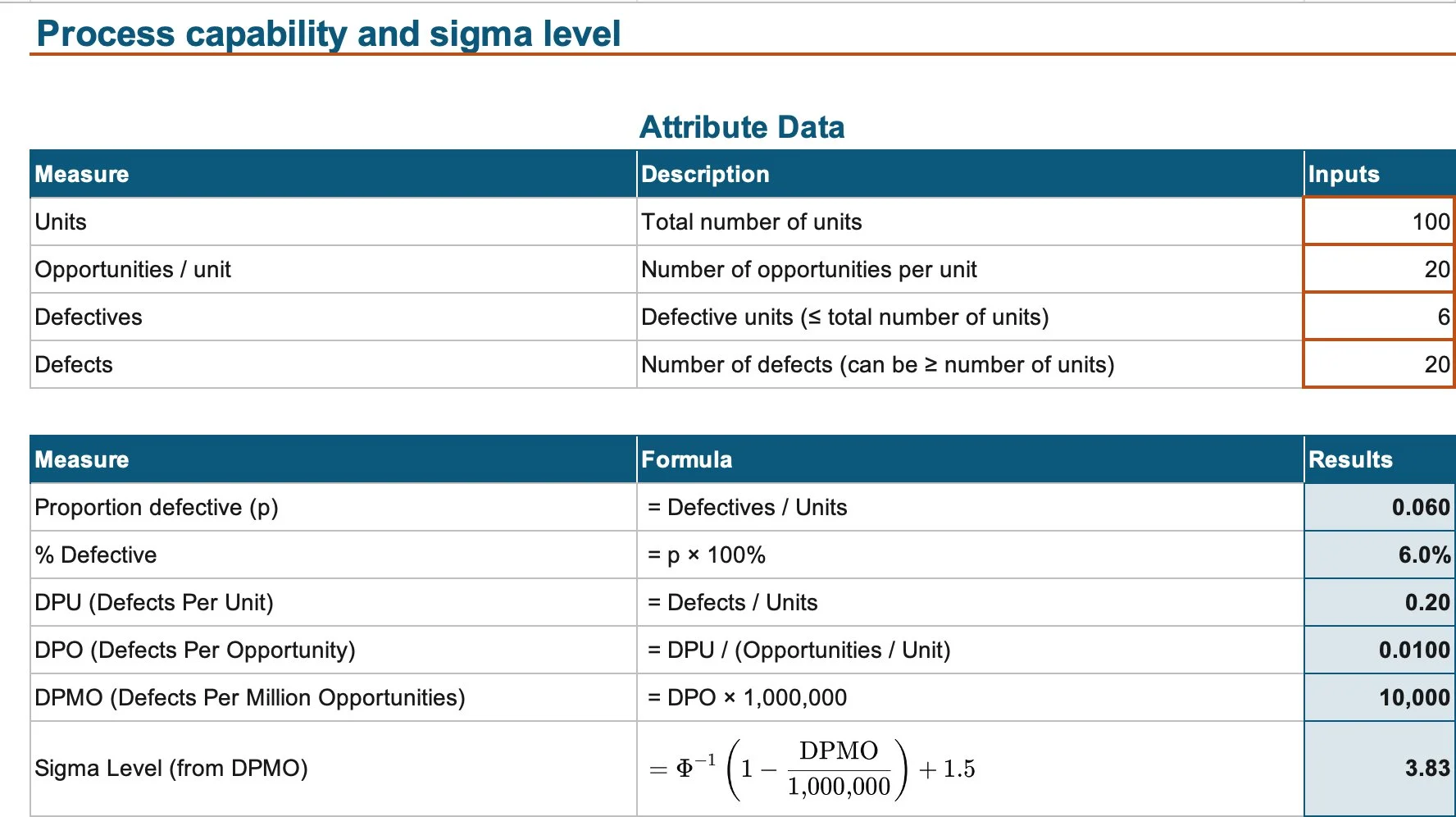
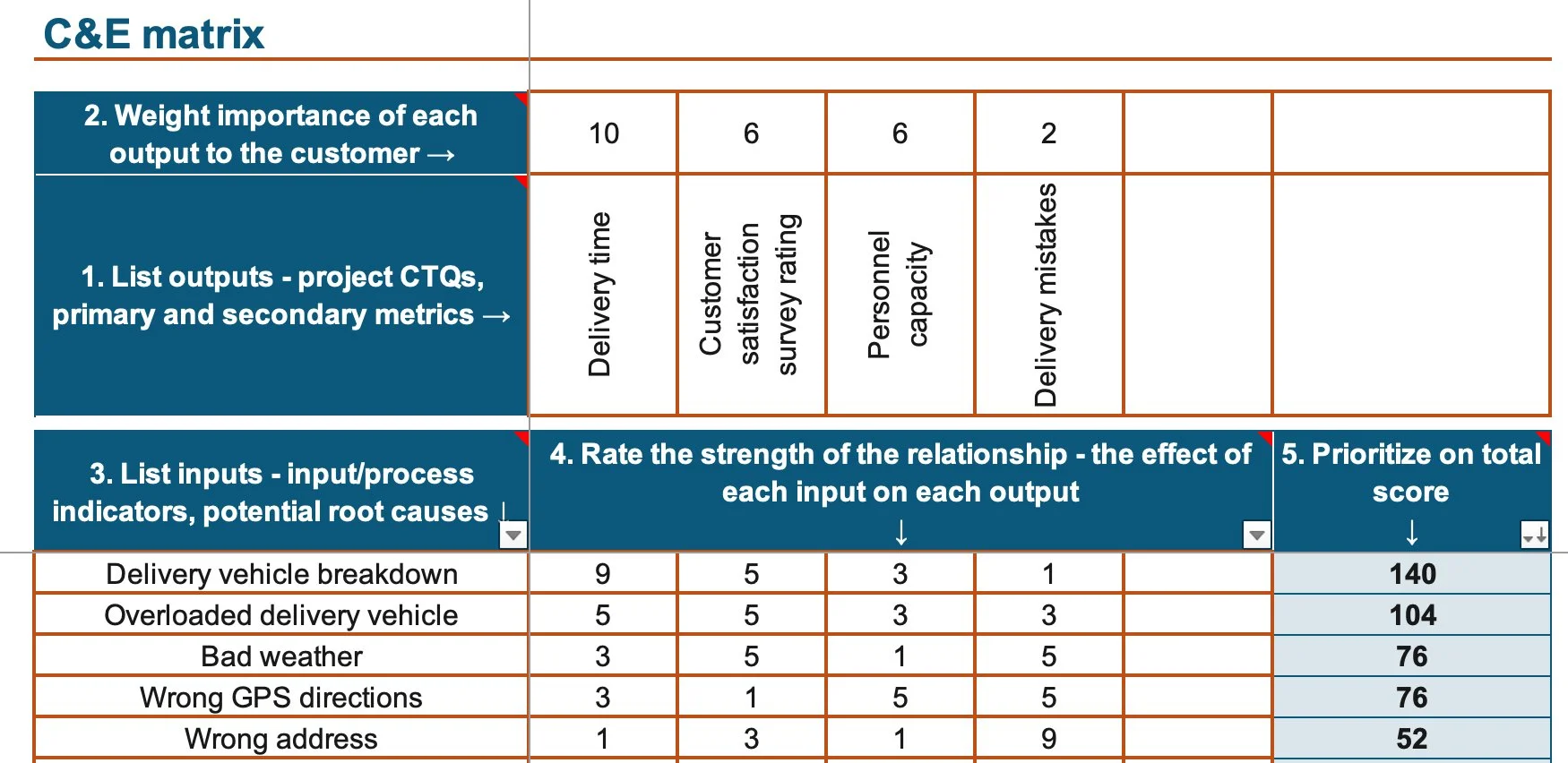
LSS toolkit with 60+ templates and tools, all in one consistent format
Practical tools learners take straight back to their projects. Every template uses the same guided-steps layout, so once a learner knows one, they know them all. A toolkit index points them to the right tool for each phase of DMAIC.
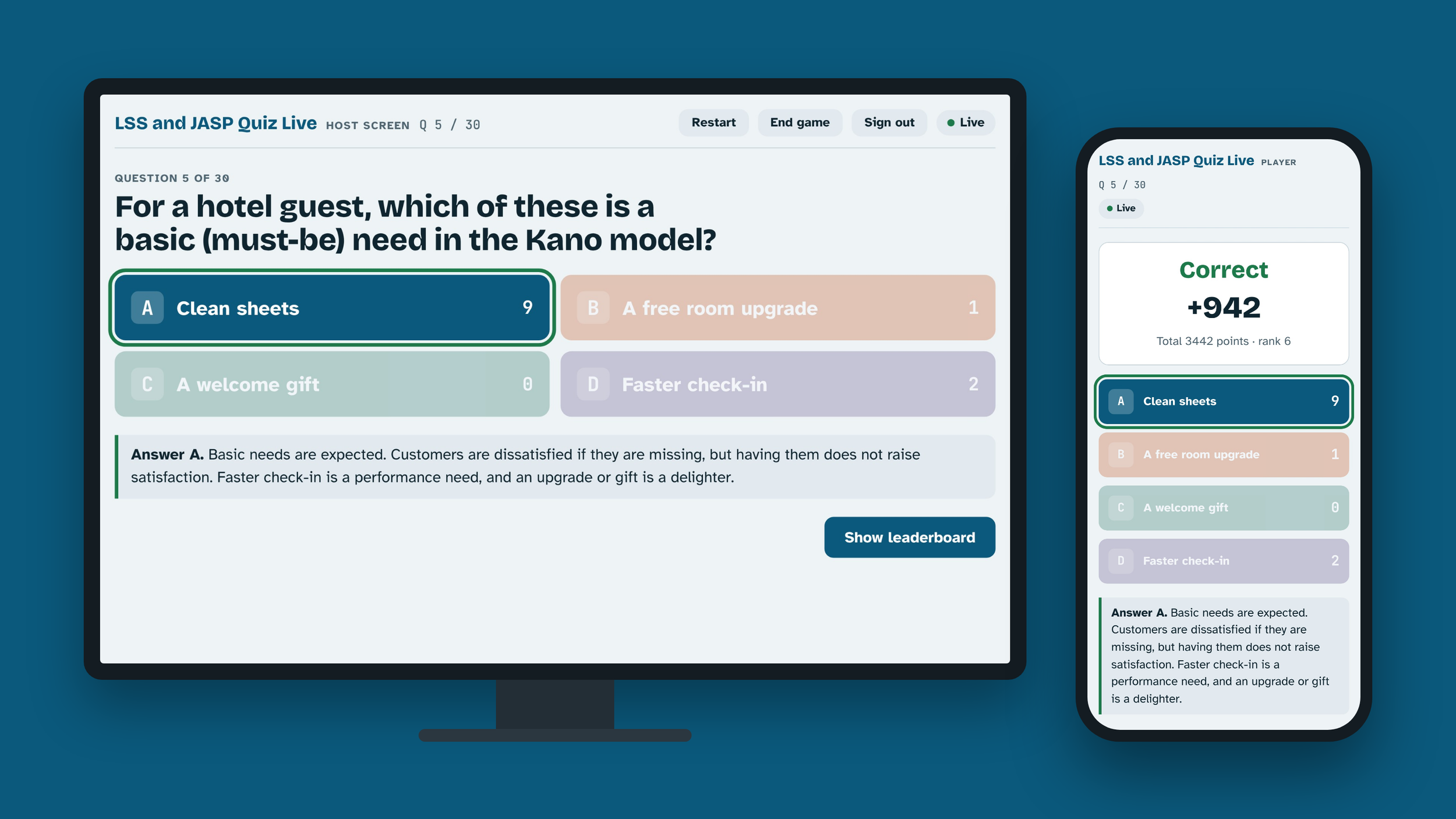
LSS and JASP quiz games
Fun end-of-day reviews
12 live quizzes, each with 30 exam-aligned questions, instant feedback, and no student accounts needed.
ACCESSIBLE BY DESIGN
Built so every learner can take part
Accessibility is built into the files from the start, not added later. That makes the materials easier for every learner and simpler for your organization to approve.
High-contrast colors
Designed to meet the WCAG Level AA contrast ratio.
Alt text on every image
In the slide deck and the student PDF.
Set reading order
Screen readers move through each slide in a logical order.
Consistent slide titles
Every slide is easy to find and navigate.
ADD TO YOUR LICENSE
Optional extras
GB and BB exam question banks
300+ questions geared to the ASQ Body of Knowledge, delivered as a spreadsheet so you can test learners in whatever system you already use.
$2,500 one-time
Train-the-trainer
Prepare your instructors to teach the materials with confidence. Recommended as 2 days in person.
from $8,000
Companion book
The Lean Six Sigma and JASP Memory Jogger, published by GOAL/QPC. A reference that supports the training.
Coming soon
White-label, multi-year, and perpetual options are available on request. Contact Sarah for details.
See the materials for yourself
Request a sample module to see how the slides, student PDF, JASP data, and LSS Toolkit work together in a real lesson.